Contradiction, facts, and geometry
- Agentic AI
- Agentic memory
- Research
When an agent’s memory opens the doors to a complex and uncertain world
First article in the series on Cercle Digital’s research work on agentic harnesses and memories, describing the fundamentals of our memory technology
From memory as storage to memory as structure
The first memory systems for agents answer a fairly intuitive problem: allowing an agent to keep what it has seen, learned, or done so that it can reuse it later.
Depending on the architecture, this memory takes the form of a conversation history, a set of facts, a vector database, summaries of past episodes, or a world state maintained over the course of execution. These mechanisms mainly answer one question: which information needs to be retrieved now?
This approach works as long as the problem essentially consists of memorizing and then recalling.
But an agent that acts durably in an environment quickly runs into an additional difficulty. The accumulated pieces of information are not merely numerous; they maintain relations with one another that are sometimes contradictory.
Two different situations may have been recorded under the same state. A reward that looks locally advantageous can draw the agent into a loop. Some information may be missing not because it was forgotten, but because it was never observed.
At that point, improving the memory is no longer just a matter of storing more information or retrieving it better. You need to be able to examine its structure.
Current agentic architectures rely largely on an assembly of functions defined in advance: memory, world model, value function, belief revision mechanisms, state representation, or the distinction between what the agent causes and what the environment produces. These building blocks are chosen, separated, and articulated by engineers. Their division is therefore not a consequence of the agent’s observed behavior, but an architectural hypothesis laid down before it runs.
This choice is necessary in practice, but it makes the system’s performance dependent on heavily oriented engineering: you have to decide which faculties must exist, which information each must keep, and how they must interact. A division or representation error can then end up buried throughout the architecture.
This is precisely the problem studied in “One Operator, Four Faculties.”
The paper explores another possibility: reducing these prior choices as much as possible by letting certain distinctions emerge as measurable consequences of the agent’s activity rather than as modules imposed at design time. If its transitions, rewards, actions, and beliefs are represented as flows on a graph, several phenomena usually treated separately could then appear as different components of one and the same mathematical object.
The paper starts from a simple proposition: several phenomena that agent architectures usually handle with distinct mechanisms could be read as different properties of one and the same mathematical object, provided the agent’s activity is represented as flows on a graph.
To picture simply the logic the paper carries, we suggest looking at the problem from a geographical angle.
Reliefs, loops, and obstacles
Imagine two towns connected by several paths.
Every move has a cost. If that cost depends only on altitude, it can be represented by a relief map. Climbing increases the cost, descending reduces it. Whatever route is taken between two points, the total difference depends only on their respective altitudes.
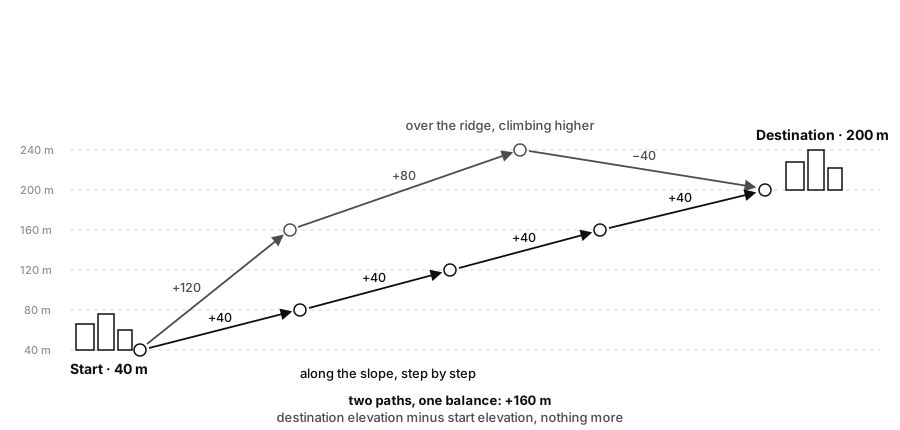
In mathematics, such a quantity derives from a potential. On a graph, the part of a flow that this potential explains constitutes its gradient component.
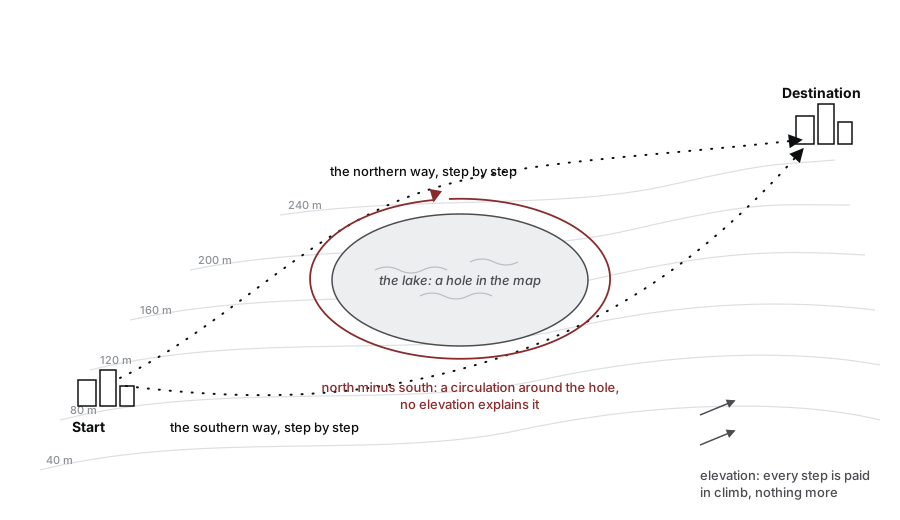
Now let us add a lake between the two towns.
You can pass by the north or by the south, but you cannot cross the obstacle directly. The difference between these two routes can no longer be explained by altitude alone. It depends on how the paths go around the lake.
This information corresponds to a circulation tied to the global structure of the network: its harmonic component.
There is, finally, a third situation.
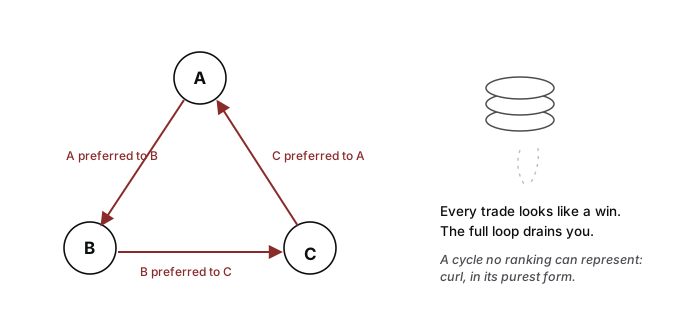
Consider three places A, B, and C. Going from A to B seems advantageous. From B to C as well. From C to A too. Yet after completing the full loop, you are back at your starting point while having accumulated three successive gains.
No potential function can produce such behavior: on a consistent relief, the balance of a closed loop is zero.
Here the defect is local. It sits in the cycle itself. This is the curl component, which can be interpreted as a local circulation or a whirl.
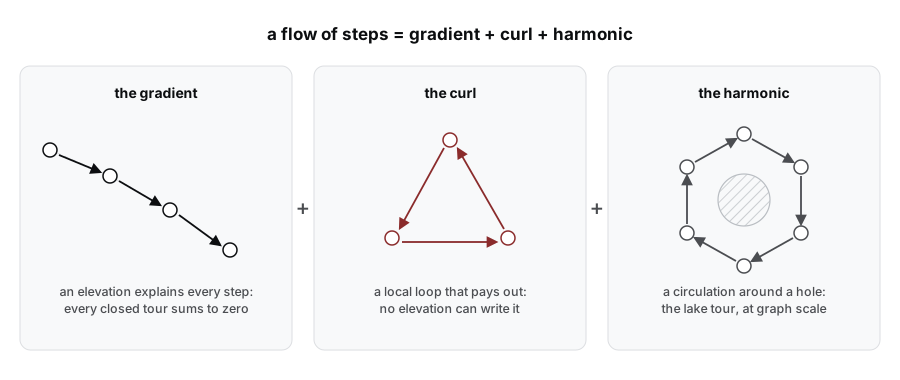
The combinatorial Hodge decomposition formalizes precisely this separation. A flow defined on the edges of a graph can be decomposed into components corresponding to the gradient, the curl, and the harmonic part.
The computation is deterministic and requires no learning. It acts as an analysis instrument applied to the flows produced by the system.
That is the property the paper proposes to exploit.
Reading an agent’s activity as a flow
An agent naturally produces many flows.
It moves from one state to another. It receives rewards. Its commands modify certain variables. Observations strengthen or weaken beliefs. Arguments can support competing conclusions.
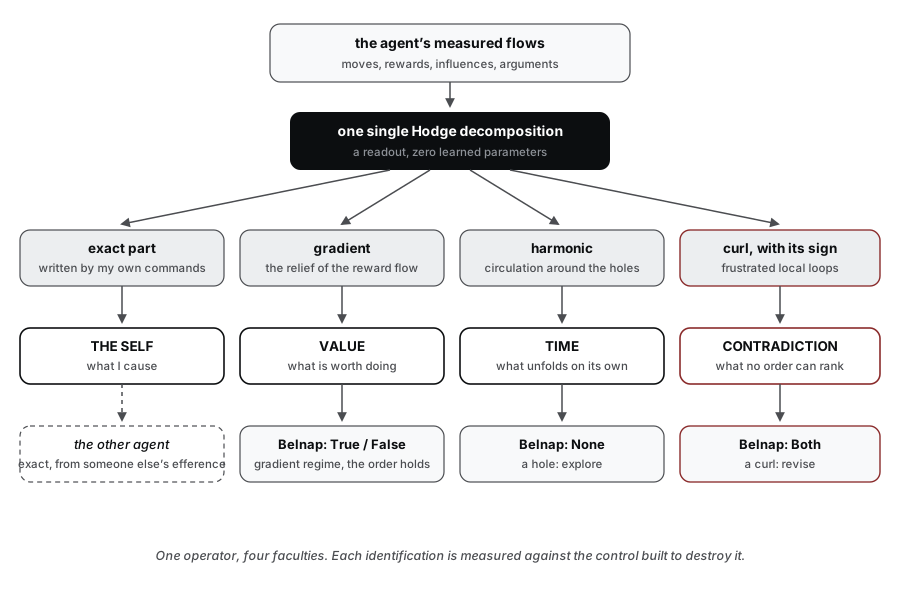
The paper hypothesizes that several properties traditionally represented by separate modules can be identified directly in the geometry of these flows.
The first concerns value.
In a consistent decision process, value behaves like a potential: certain transitions climb or descend on a relief of preference. The gradient component of the reward flow therefore describes the part that can be represented by a global value function.
The second concerns temporal dynamics.
Some evolutions of the system follow a circulation of their own, independently of the agent’s immediate actions. This component makes it possible to distinguish what comes from the world’s autonomous dynamics from what belongs to other sources of variation.
The third concerns the agent’s own action.
When a copy of the commands issued by the agent is available, it becomes possible to isolate the part of the flow directly attributable to those commands. The question is then no longer merely to note that a change occurred, but to identify the share actually caused by the agent.
Finally, the curl provides a measure of local inconsistencies.
A set of circular preferences, a feedback cycle incompatible with a causal order, or a state representation that merges different situations can produce the same signature: a loop that no global potential can explain.
The paper also connects this geometry to Belnap’s four-valued logic.
In this reading, a flow with a consistent orientation corresponds to information that can be ordered as true or false. A contradiction produces a circular structure. An absence of information corresponds, by contrast, to a circulation around a hole in the observed structure.
The point of this correspondence is not to replace one terminology with another. It is to allow several diagnostics to rest on the same computation.
How our research paper evaluates these intuitions
Associating value with a gradient, time with a circulation, or contradiction with a curl would be of little interest if these connections were mere analogies.
For each correspondence, the paper therefore seeks to build an experiment capable of refuting it. The principle is always the same: start from a system whose structure is known, modify precisely one property, then verify that the geometric component supposed to correspond to it is the only one to react.
The case of value makes this method clear.
Can a useful reward be told apart from a reward that leads in circles?
Consider an agent that must choose its actions in an environment in order to maximize a reward.
Each transition between two states carries a certain value. The set of these values forms a flow on the state graph: each edge indicates what the agent gains or loses when moving from one situation to another.
Two perturbations can then have exactly the same magnitude while possessing very different structures.
The first is conservative. It amounts to adding a relief to the reward landscape: some states become relatively higher or lower, but the differences remain compatible with a global value function. If the agent walks a loop and returns to its starting point, the gains and losses added by this perturbation cancel out.
The second is circulating. Here, the rewards are arranged so as to favor, in succession, several transitions forming a loop. Each move may look locally advantageous, but no global potential can explain the whole: after a full lap, the agent returns to the same state while having accumulated signals that push it to start again.
This is precisely what the Hodge decomposition calls curl.
The experiment therefore consists of giving the agent two perturbations of the same magnitude: one built as a gradient, the other as a circulation. If only their intensity mattered, they should affect its behavior in comparable ways. If the geometry proposed by the paper is relevant, their effects should instead be radically different.
That is what is observed.
The conservative perturbation preserves the optimal policy, in line with the classical result of Ng, Harada, and Russell on potential-based reward shaping. The circulating perturbation, for its part, draws the agent almost entirely into the loop: the capture measure reaches 0.991, while optimality falls from 1.000 to 0.327.
The important point is therefore not simply that a bad reward was added. The two perturbations were built with comparable magnitude. What distinguishes them is their organization in the graph.
One can be explained by a potential.
The other contains a loop.
Removing only the loop
A correlation, however, would not be enough to establish that the curl is indeed responsible for the phenomenon.
The paper therefore runs a second experiment: it keeps the perturbation, but mathematically removes its curl component using the Hodge decomposition.
If the hypothesis is correct, removing this single component must make the capture of the agent disappear.
That is what happens: optimality returns to 1.000.
The test also provides an additional piece of information. The curl energy does not merely signal that an inconsistency exists somewhere in the system; it makes it possible to find the loop that was introduced experimentally.
In other words, the same computation answers two different questions:
- does the reward flow contain a structure incompatible with a global value function?
- if so, where is that structure?
The example is close to what economists call a money pump. Imagine three trades A → B, B → C, and C → A that each look advantageous when examined separately. An agent that follows only these local preferences can be led to walk the loop indefinitely.
The problem then comes from no single transition taken in isolation. It appears only when their collective structure is examined.
That is exactly what the curl measures.
The same falsification logic for the other correspondences
The other experiments follow the same principle: identify what should affect one component, then build a control that should leave the others intact.
To test the temporal component, the paper notably compares a system exhibiting irreversible dynamics with a twin built to be reversible, then artificially shuffles the order of the observations.
To test the share attributable to the agent’s own actions, it provides the agent with a copy of its commands, then replaces this efference copy with a false one.
To test contradiction, it compares a causal organization compatible with a global order to a structure into which a feedback cycle has been deliberately introduced.
The goal is therefore not to note after the fact that the results look like gradient, curl, or circulation. It is to modify separately the properties supposed to produce these components and to verify that the instrument reacts precisely where it should.
When a bad state produces a contradiction
The first experiments deliberately use synthetic environments in order to control precisely the phenomena injected.
The paper then tests its approach on Colossal Cave Adventure, the text adventure game created by William Crowther and Don Woods in the 1970s.
The environment has 141 rooms and several puzzles whose solution depends on information that is not contained in the player’s position alone.
It is a classic example of the state representation problem.
Suppose the agent’s memory represents a situation solely by the name of the room it is in.
Two visits to the same room are then considered identical, even if the agent holds an object in one case and not in the other, or if a prior step of the puzzle has already been completed.
The observed state is therefore no longer Markovian: it does not contain enough information to correctly predict the consequences of future actions.
In this raw representation, value iteration reaches a success rate of only 0.06 on the prerequisite chain studied.
Here the geometry provides an interesting diagnosis.
Merging under one state several situations that in reality have different consequences produces transitions incompatible with a single potential. This inconsistency appears in the form of a curl.
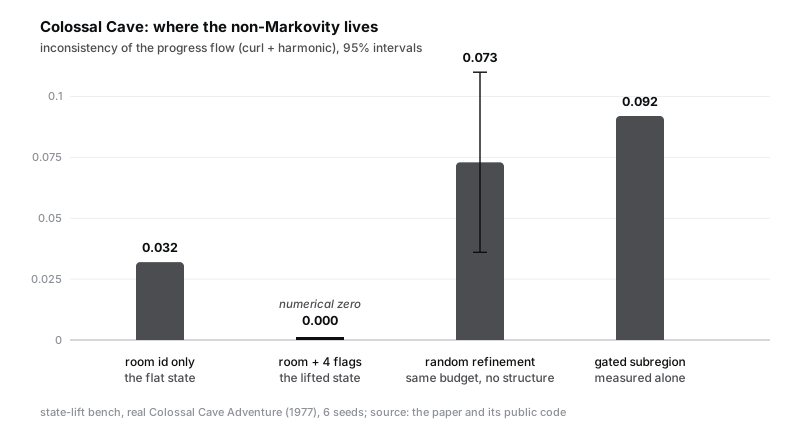
On the state represented by the room alone, the measured inconsistency is 0.032 and concentrates precisely on the areas containing the progression locks.
When four relevant variables are added to the state representation, this value drops to 0.000.
A random enrichment containing the same number of variables does not solve the problem. The inconsistency increases instead, to 0.073.
Adding memory is therefore not enough. You have to add the right information.
Structure can also point to what is missing
The next result is probably the most directly interesting one for the design of agentic memories.
The system does not merely detect that a state representation is insufficient. It can evaluate different possible enrichments by measuring the curl reduction they would produce.
In the experiment, the snake-related variable, prop:snake, thus comes first among the candidates and by itself explains all of the non-Markovianity actually visible in the graph studied. The random variables, by contrast, obtain negative scores.
The method nevertheless runs into a fundamental limit.
Some important transitions do not change the room the player is in. They are therefore invisible in the graph built solely from movements between rooms.
No passive analysis can discover a difference that does not appear in the observations used to build the graph.
The paper therefore complements the geometry with active interventions: the agent tests certain hypotheses by deliberately modifying its environment.
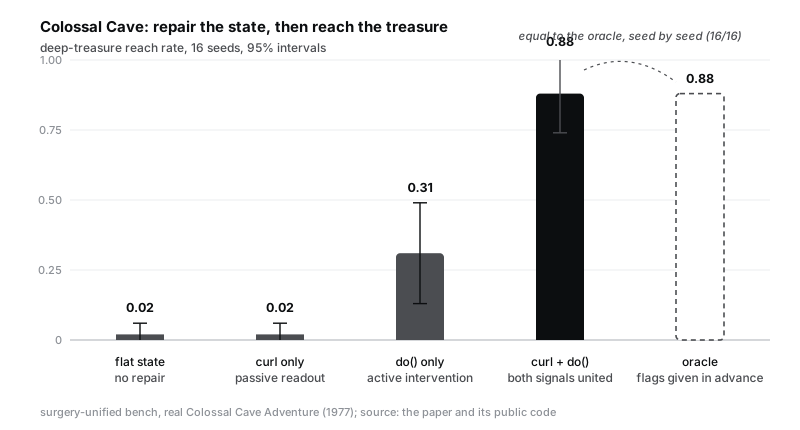
Geometry alone does not reach the deep treasure. Intervention alone obtains a success rate of 0.31.
By combining the two, the system reaches 0.88, exactly the level obtained by an oracle given the right state variables from the start, and does so on all sixteen seeds tested.
The distinction is important.
Structural analysis indicates where the current memory becomes inconsistent and which observable variables could repair it. Intervention makes it possible to discover the information whose absence leaves no trace in the existing representation.
An agent’s memory thus does not merely become richer. It can become revisable based on its own inconsistencies.
Toward a memory that can diagnose its representations
This perspective slightly changes the way the problem of agentic memory is posed.
A conventional memory mainly seeks to answer questions such as: what have I already seen? Which fact resembles the present situation? Which episode should I recall?
A structural memory should be able to answer additional questions:
Why do two apparently similar experiences lead to different consequences?
Can my preferences be represented by a consistent ranking, or do they form a loop?
Does a contradiction come from incompatible information or simply from missing information?
Does the state I use contain enough variables to explain the observed transitions?
What additional information would actually reduce this inconsistency?
Perhaps the most interesting result of the paper is that several of these questions can be reduced to the same operation on different flows.
A cyclic reward, a contradiction between beliefs, and a state representation that merges two different situations seem to belong to distinct domains.
Geometrically, they can nevertheless produce the same type of defect: curl.
The repair then depends on the domain concerned.
In a reward field, it may mean removing the circular component that captures the policy.
In a belief base, it may mean revising the information involved in the loop.
In a state memory, it may mean introducing an additional variable capable of distinguishing two situations previously conflated.
Conversely, a circulation associated with a hole in the observed structure signals a different problem: information is missing.
In that case, revising what the agent already believes is not necessarily the right answer. The right move is rather to explore or intervene in order to obtain new observations.
This distinction between contradiction and absence of information is particularly important for an autonomous agent. Both situations can produce uncertainty, but they do not call for the same action.
What these results allow us to state
The paper does not propose a complete new memory architecture, nor an immediate replacement for existing memory systems.
It rather provides an instrument for examining how they work.
The results show, in the environments studied, that one and the same geometric decomposition can identify several useful structures: value potential, autonomous dynamics, influence of the agent’s own actions, and local inconsistencies.
They also show, on Colossal Cave, that a state representation inconsistency can be detected and then used to guide the enrichment of that representation.
But the limits remain significant.
Most of the identifications are tested on families of synthetic environments designed to isolate the phenomena studied. Colossal Cave is a first step toward a more complex environment, but does not yet validate the approach on perceptual systems or agents deployed in real environments.
The operators used are linear.
Detecting the influence of another agent also assumes, in the present experiments, that its action signal is supplied to the instrument. Discovering that source in an unsupervised way remains an open problem.
Finally, the geometry can only diagnose the structure that actually exists in the graph it is given. Information absent from that representation remains invisible without additional observation or intervention.
These limits do not reduce the interest of the result. They specify its scope.
The claim is not that all of an agent’s cognition reduces to a Hodge decomposition.
It is more operational: when an agent accumulates experience in the form of transitions, rewards, actions, and beliefs, the structure of these flows contains information that memory mechanisms based solely on storage and retrieval do not necessarily exploit.
The Hodge decomposition provides a deterministic way to read it.
It can thus become a diagnostic tool for a generation of memories that no longer merely preserve past experience, but are able to identify their own inconsistencies, their gaps, and the dimensions of their state they should revise.
The paper
“One Operator, Four Faculties: Value, Time, Self and Contradiction as the Hodge Components of an Agent’s Flow, with Belnap’s Four Values as Its Regimes” presents the complete experiments, controls, and results, along with the protocol for reproducing them.
The paper is 16 pages long, figures and appendices included. The experimental code, the preregistered hypotheses, and the reproduction commands are published with the work.