Investors
Investing in Cercle
This page is intended for investors who want to understand Cercle better: its team, its convictions, its products. We have compiled here all the public information that can support due diligence on our activities and assets.
Building AI a company can actually answer for
We are building Beyond on a simple conviction: the main constraint on artificial intelligence in the enterprise is no longer its ability to produce an answer. It is the organisation’s ability to accept that answer fast enough to benefit from it, without giving up on verifying it, explaining it and taking responsibility for it.
Our ambition is therefore not to build one more language model, nor one more general-purpose copilot. We are building the infrastructure that turns the work of an AI into a fully evidenced, traceable and revisable result that a professional can examine, amend, accept or reject in full knowledge of the facts.
This page sets out what an investor needs in order to understand our thesis, our product, our team, our business model and our stage of development. Named information about clients, prospects, individuals and partners is deliberately not published. It can be shared under an appropriate diligence framework.
The team
Three co-founders, one senior advisor from a major IT player. One shared vision.
-
President
Co-founder, Paris
An international career with solid software grounding. Product and commercial execution: scoping offers, running deals, client relationships. Ties to Station F and to the industrial fabric of the Paris region.
-
Chief technology officer
Co-founder, Nagoya
Ten years in defence and aerospace with France’s major prime contractors. Specialist in industrialising high-performance embedded systems. Experienced in European public procurement, international technical cooperation and critical supply chains. Based in Nagoya, Japan.
-
Head of business development
Co-founder, Paris
Arts et Métiers engineer, graduate of Sciences Po and of IAE Aix-Marseille. A defence background, experienced in strategy, business development and digital project delivery.
-
Senior advisor
Adviser
Former head of Microsoft Defence, twenty-seven years in defence IT.
Our thesis
Generation is becoming a commodity, trust is not.
Models already produce text, search for information, synthesise a corpus and chain actions together. Improving that single capability further solves only part of the problem.
In a company, a recommendation is worth something only if someone can act on it. The more consequential the decision, the more that person must be able to understand what information it rests on, check its provenance, spot contradictions, weigh what remains uncertain and explain afterwards why a decision was taken.
When that verification takes as much work as the original production, the gain AI promised disappears.
-
95 %
of GenAI pilots show no measurable ROI
-
56 %
of executives do not expect to recoup their GenAI investment
-
285 bn USD
were nonetheless committed in 2025 by four major hyperscalers
Sources: MIT (95%); PwC, survey of 4,454 executives (56%); Hyperscaler accounts, 2025 (285bn USD)
That is the problem we address. We are working to scale verification rather than generation alone.
Our design principle follows directly: the human remains responsible for the decision. Beyond is not meant to hide that responsibility behind an autonomous system. It organises the preparatory work needed for the human decision to be taken quickly, explicitly and on defensible grounds.
This approach strikes us as particularly relevant in environments where an error engages a clear responsibility: critical industry, defence, energy, regulated finance, compliance, risk management, business intelligence or supply chain surveillance.
Product and value proposition
Beyond builds the case. The human decides.
Beyond is an agentic framework designed to produce what we call a Human Review Package.
A Human Review Package is not simply a model answer with a few sources attached. It is a case file built for a given class of decision. It gathers what human arbitration requires: the proposed result, the supporting evidence, the provenance and freshness of the information, any contradictions, the level of confidence, the useful context and what remains to be examined.
In an industrial surveillance case, for example, the system can detect a signal concerning a critical supplier and hand the professional the identified event, the items that support it, their freshness, the contradictory information and the relevant courses of action. The analyst no longer has to reconstruct the whole file before being able to take a position.
Our value proposition rests on that difference: we do not sell more information to verify. We work to reduce the cost of verification itself.
An architecture in four parts
-
The Enterprise Knowledge Backbone
The EKB is the memory of the system. It treats knowledge not as a set of definitively established facts, but as beliefs that are sourced, dated, versioned and revisable. A piece of information can change, be contradicted or lose its validity without its history disappearing.
-
The Core
It is the production and control layer. It handles identities, rights, data access, observability and traceability. It also organises case-building according to the standards of the trade concerned.
-
The Companions
These are the business agents that work on top of this infrastructure. They inherit strictly the rights of the person they assist: the agent never becomes a way around the company’s access policies.
-
The Human Review Package
This is the object handed to the user for arbitration. It is the interface between the work of the machine and human responsibility.
The whole is designed to be deployable in the cloud, in a sovereign environment or on premises, and not to depend structurally on a single model vendor. The choice of language model remains a parameter of the architecture rather than its foundation.
A memory that accepts contradiction
The main technological distinction of the EKB lies in the way it represents knowledge.
A traditional repository generally seeks to build a coherent representation of the world. When several sources contradict each other, one has to decide which is right, reconcile the data or change the ontology.
We chose a different approach. A contradiction is itself information. It must be preservable, locatable, attributable to its sources and resolvable once enough material becomes available.
A belief therefore stays open to questioning about its evidence, its contradictions and its history. The event log that carries this evolution is immutable and replayable.
This property matters for auditability, but also for the economics of the product: the structures common to a domain can be reused while the knowledge proper to each company stays isolated. We are seeking client specialisation and industrialisation of the platform at once, rather than choosing between a generic product and bespoke development.
Research, patents and intellectual property
We base our product on internal research, and we are not afraid to put it before the judgement of our peers. Our approach is rigorous and scientific, and we draw a clear line between what is a scientific hypothesis, what has been measured experimentally and what is demonstrated in production.
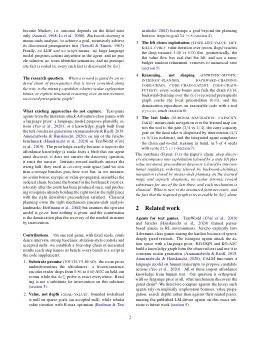
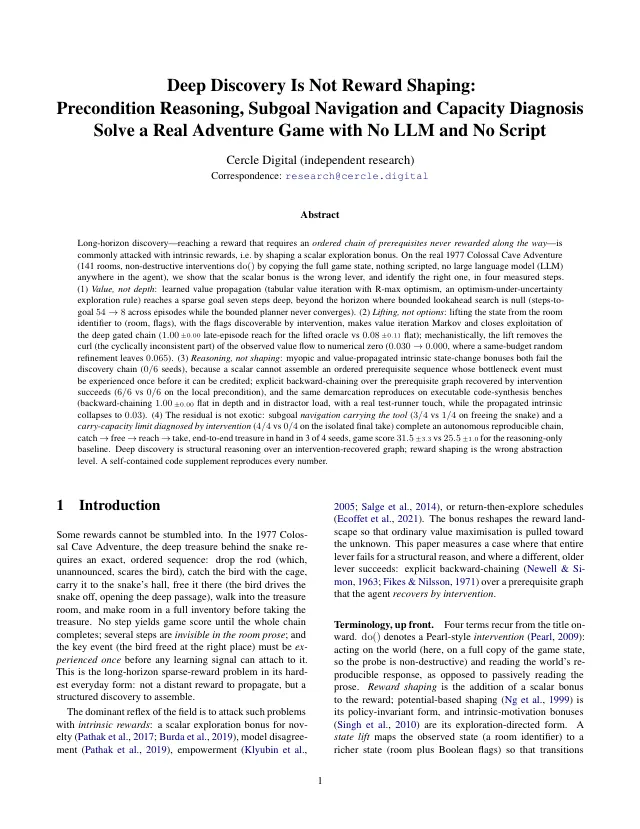
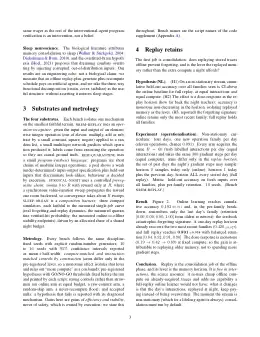
The papers presented below are an extract from our ongoing research on the structural components of GenAI agents: we do not merely use commercial models, we build our own architectures in order to control every performance parameter. Our products are built on hybridising our in-house technologies with commercial models, so as to improve the precision, the fidelity and the exhaustiveness of what our models return. We are also working on the technologies underlying World Models, in order to exploit some of their properties applied to LLMs.
-
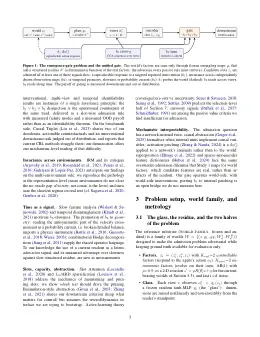
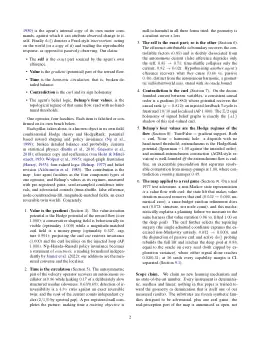
What Makes a Latent Real?
Every passive criterion fails, each in its own way. What an agent perceives is real only if intervention confirms it: three signals the observation map cannot counterfeit.
16 pages · 190 KB
Download the PDF -
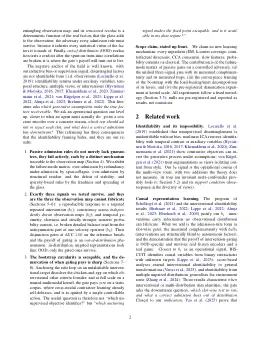
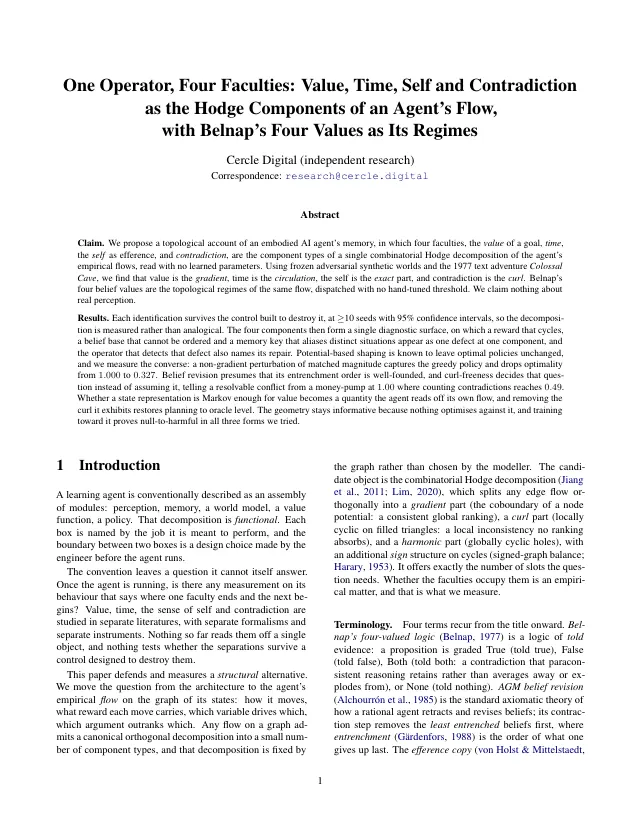
One Operator, Four Faculties
Value, time, self and contradiction are the four components of one decomposition of an agent’s memory. Measured, with no learned parameter, they name the defect and its repair.
17 pages · 198 KB
Download the PDF -
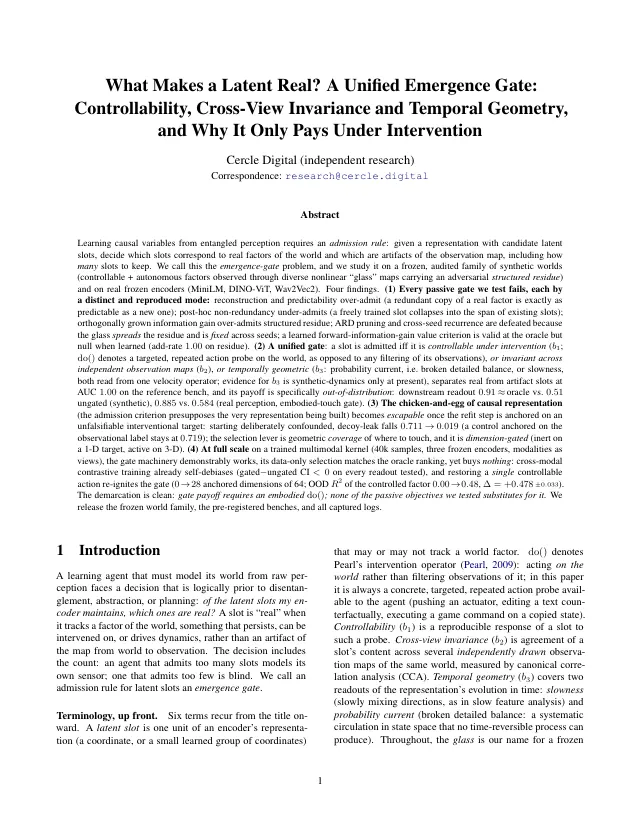
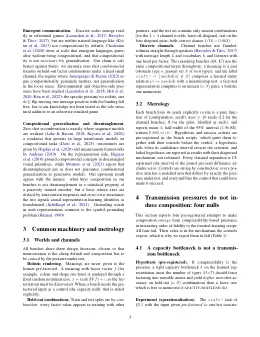
Compositionality Needs More Than Iterated Learning
Passing a code from generation to generation is a weak lever. What makes grammar emerge is counterfactual pressure: one factor changes under intervention, one word moves.
12 pages · 146 KB
Download the PDF -
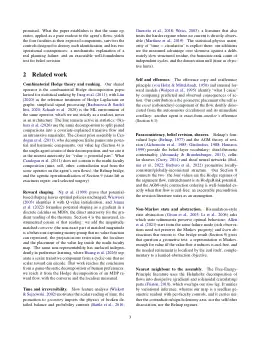
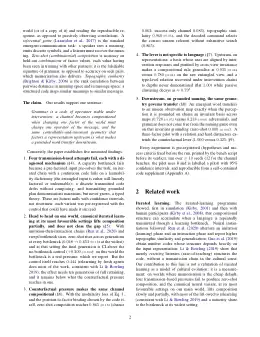
The Name Is the Bridge
Wiring an agent into a frozen language model through vectors returns nothing. The rented reasoning lives in the choice of word, which is to say in the discrete step.
11 pages · 125 KB
Download the PDF -
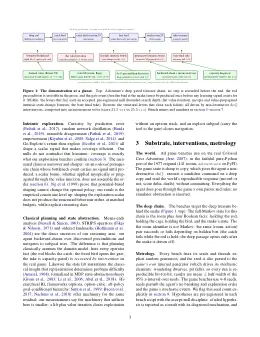
Deep Discovery Is Not Reward Shaping
On a 1977 adventure game, with no script and no language model, an agent reaches a goal seven prerequisites deep. The lever is not an exploration bonus but precondition reasoning.
12 pages · 136 KB
Download the PDF -
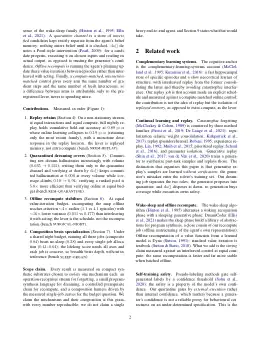
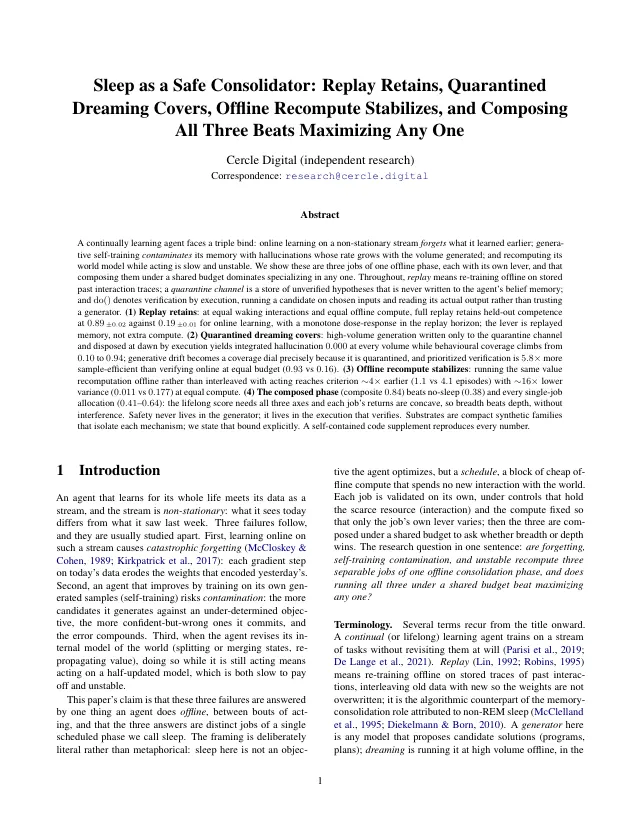
Sleep as a Safe Consolidator
Replay retains, quarantined dreaming covers, offline recompute stabilizes. Composing the three beats maximizing any one, and nothing dreamt enters memory without execution.
9 pages · 112 KB
Download the PDF
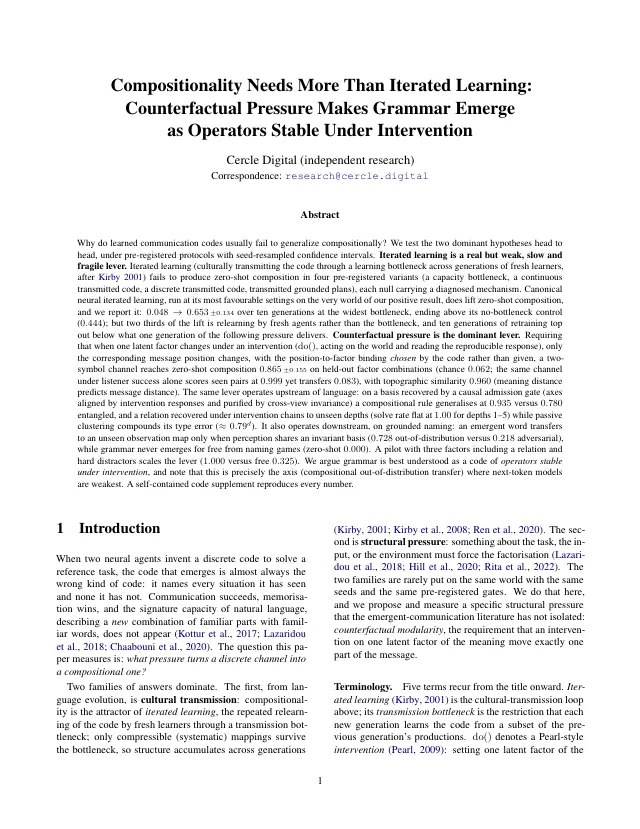
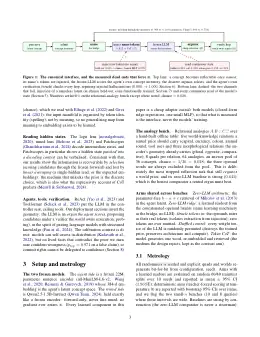
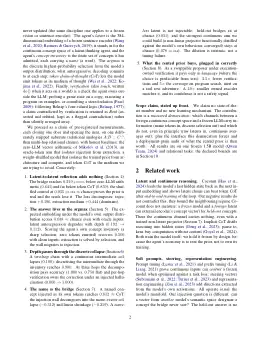
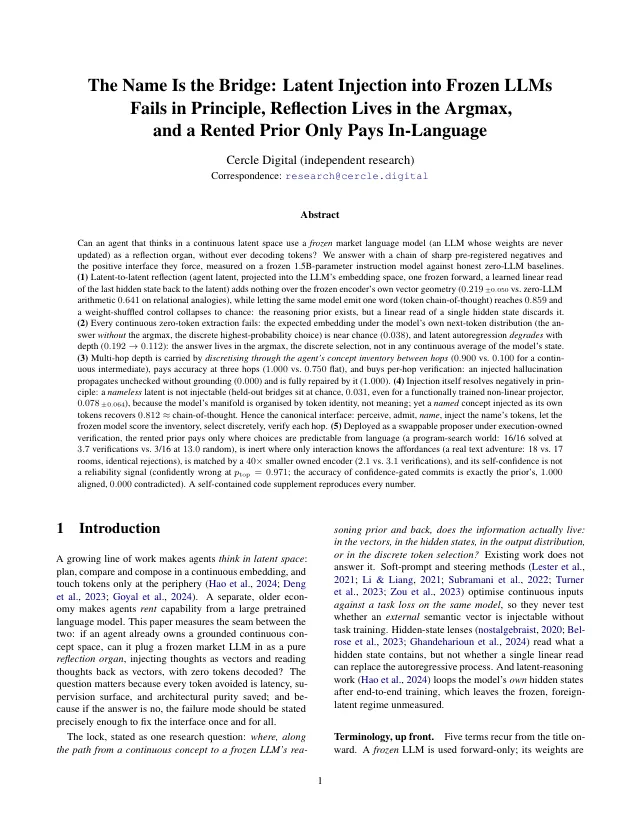
Three patents are also drafted and ready to file, on agentic memories and GenAI execution harnesses.
The company’s model
We are not trying to sell seats. We sell a case already built.
The economic unit we want to sell is not access to an interface. It is an operated business Companion, able to produce Human Review Packages continuously for a given business process.
The Beyond platform is the means of production of that service and a large part of our technological barrier. It is not, in itself, the product we ask the client to administer.
The model has three levels
-
Set-up, or build
It covers scoping the domain, connecting the necessary sources and formalising the case-building standards. It is invoiced up front.
-
The Beyond platform
Made up of the EKB and the Core in particular, it maintains the memory, the access rights and the explainability mechanisms. It is a recurring component.
-
Operations, or run
They cover the continuous work of the Companions and their improvement. They are recurring as well.
We keep the option of billing partly on usage or on outcome where the outcome is objectively attributable and we control the inputs sufficiently. We refuse, however, to make the economics of the company depend on a promise of results that external data or a human decision could put beyond our control. The recurring platform therefore remains the base of the model.
We are not a services company
The obvious risk of an operated model is becoming a consultancy that rewrites its product for every client.
Our architecture is designed precisely to avoid that drift.
Connectors, domain schemas, belief structures, case-building standards, Human Review Package templates and review workflows are meant to become reusable assets. What is common to a domain is capitalised. What genuinely belongs to a client stays isolated at that client.
Margin should therefore rise with reuse rather than with the number of hours billed.
It is also why we track reuse per domain as a strategic metric, alongside retention and the gross margin of the platform and operations.
Where we stand
We are at pre-seed stage. Here is what is established today, with no favourable rounding.
-
The company operates from two countries
France and Japan, with the time coverage that gives and the commercial presence it requires on both sides.
-
Three letters of intent signed for a pilot
Three companies have signed a letter of intent for a pilot project of our solution. A letter of intent is neither a contract, nor a promise to contract, nor a purchase commitment, and it carries no exclusivity: it says a need is recognised and a budget is being discussed. The amounts below are indicative, and the signatories stay anonymous, confidentiality being the counterpart of their signature.
-
The internal reference is written and applied
It is versioned, it provides for its own annual audit, and every one of its rules can be invoked by anyone, including against the founders.
The three use cases under letter of intent
-
Space
- Need covered
- Component obsolescence monitoring and supply chain surveillance: securing the availability of critical parts, anticipating obsolescence, and cutting the analysis time this watch consumes.
- Pilot scope
- The full bill of materials of one system and its critical suppliers.
- Amounts discussed
- €40,000 excluding tax, indicative, for pilot setup and operation, plus a variable share indexed on actual usage.
- After the pilot
- Six months of evaluation, then a joint decision on moving to production against the agreed success criteria. The usage-based variable share applies from the pilot onwards.
Letter signed in
-
Industrial electronics
- Need covered
- Electronic component monitoring, supply chain analysis and surveillance with an alerting system, serving a stated industrial sovereignty objective.
- Pilot scope
- Three users for the duration of the pilot.
- Amounts discussed
- €40,000 to €50,000 a year, indicative, to be set out in a commercial proposal.
- After the pilot
- Six months of evaluation, then a joint decision on moving to production against the agreed success criteria.
Letter signed in
-
Consulting
- Need covered
- Institutional and digital monitoring, corporate knowledge management and exploitation, within a strategy of turning in-house expertise into software.
- Pilot scope
- Two users for the duration of the pilot.
- Amounts discussed
- €15,000 to €25,000 a year, indicative, to be set out in a commercial proposal.
- After the pilot
- Six months of evaluation, then a joint decision on moving to production. An extension to the signatory’s own clients is contemplated, with access rights differentiated by information scope.
Letter signed in
The round
We are raising €500k in pre-seed equity.
The round funds eighteen months of runway, the time it takes to turn our design partners into measurable proof.
-
500 k€
in equity
The pre-seed round itself.
-
100 k€
non-dilutive
Public schemes targeted: BFT, JEI status, research tax credit.
-
18 months
of runway
The time to turn our design partners into measurable proof.
-
370 k€
Team
Four full-time equivalents, two in Paris and two in Nagoya, founders included. Half the team in Japan, where the loaded cost is markedly lower.
-
50 k€
Infrastructure
Compute, hosting and production tooling.
-
40 k€
Structure
Company costs, including the creation and upkeep of the Japanese entity.
-
40 k€
Go to market
Pre-sales, travel and qualification of target accounts.
The trajectory
-
Seeding, from T0 to T0+6
Closing the pre-seed, JEI status, BFT and research tax credit filings. First engineers hired, two to three design partners engaged.
-
Proof of the model, from T0+6 to T0+18
Converting pilots into recurring revenue and signing contracts with contracted expansion tiers. Five to ten clients.
-
Scale, from T0+18 to T0+36
Stepping up the pace and extending to the other markets identified. The seed round is then prepared on recurring revenue and the schemes that come with it.
The €100k of non-dilutive funding is not secured: these are schemes the company is eligible for, whose filings go in during the first six months. The plan does not count them as revenue, and the runway holds without them.
Get in touch
Does our thesis chime with yours? Do you think we could go further together? Get in touch and let us talk. The first coffee is on us.
Get in touch